Biological systems have a remarkable ability to build themselves. Nowhere is this more evident than during embryonic development, when cells coordinate to build the intricate tissues and organ systems which comprise a multicellular organism.
Recent breakthroughs in stem cell biology have shown that groups of cells can build a variety of embryo- and organ-like structures in vitro (e.g. organoids; embryo models), even without many of the patterning cues which guide development in vivo. This suggests that at least some aspects of development are self-organizing: that is, they emerge from fundamental intercellular interactions, no top-down blueprint required.
Organoid models raise fundamental questions: how do organoid ‘programs’ emerge from signaling interactions? How do top-down cues guide self-organization? And how does synthetic development in vitro correspond to real embryonic development in vivo?
Our research group uses organoids to decode and recode multicellular self-organization. Our strategy deploys synthetic biology as a toolkit to read and write developmental signals, so that we can interrogate developmental programs and test predictions of mechanistic models.
Research in the group is currently focused on three general themes:
Decoding self-organization
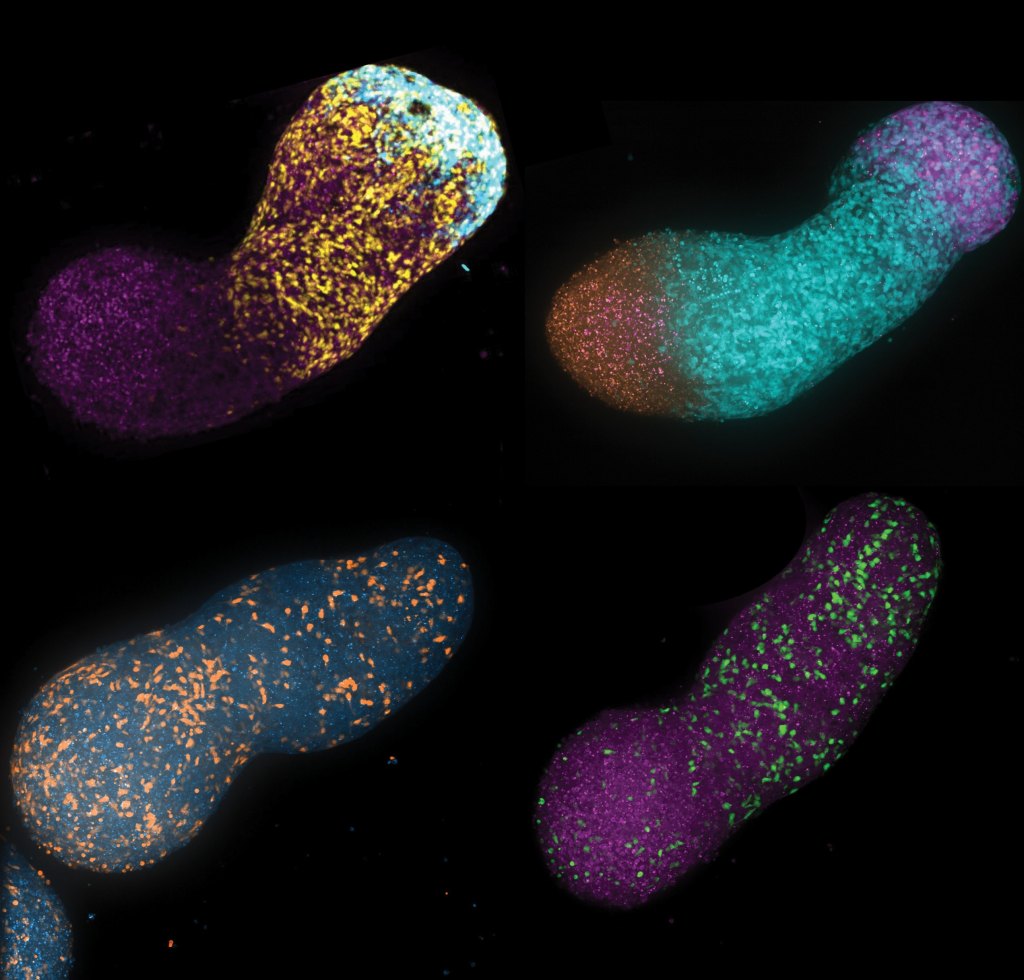
How can we link self-organized organoid outcomes to underlying signaling programs? Our strategy is to program cells to record signaling activity in different developmental pathways. By linking future cell fates to early signaling states, we can identify which cues which break symmetry to build multicellular complexity and test theoretical models of pattern formation.
Controlling self-organization
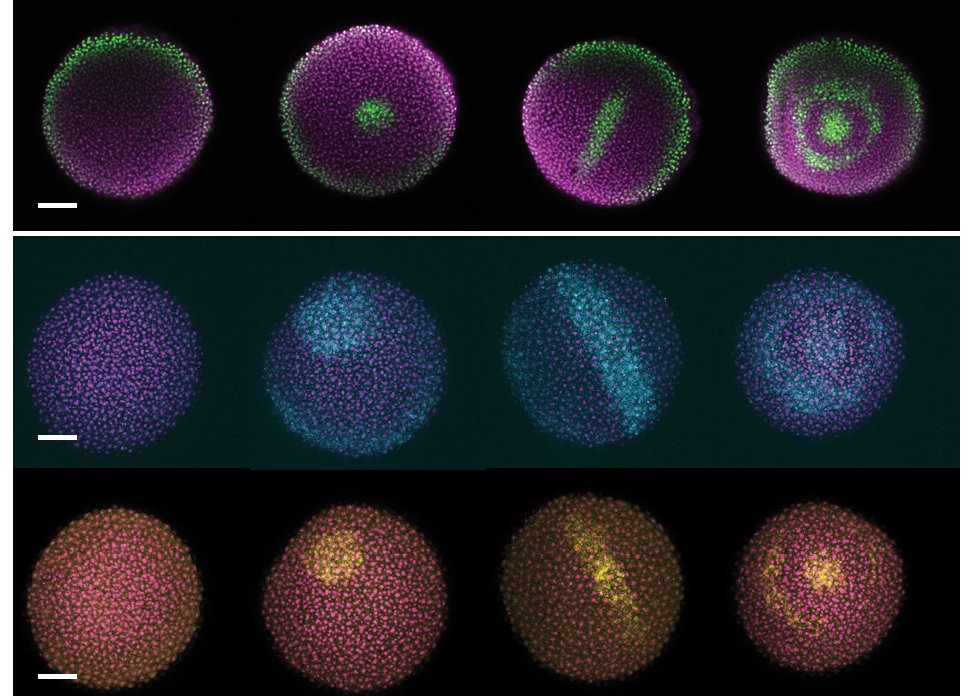
Development in vivo is guided by spatial cues. How does this top-down patterning information guide bottom-up programs of self-organization? We use optogenetics to paint synthetic patterns of signaling activity onto organoids and embryos to guide their development.
Electrophysiological pattern formation
Bioelectrical tissues can in principle give rise to to reaction-diffusion patterns thought to mediate aspects of embryonic development. New tools for optical electrophysiology (i.e., controling and measuring electrical activity with light) open new opportunies to explore bioelectrical pattern formation in both synthetic tissues and in embryonic development.
 McNamara Lab at Yale